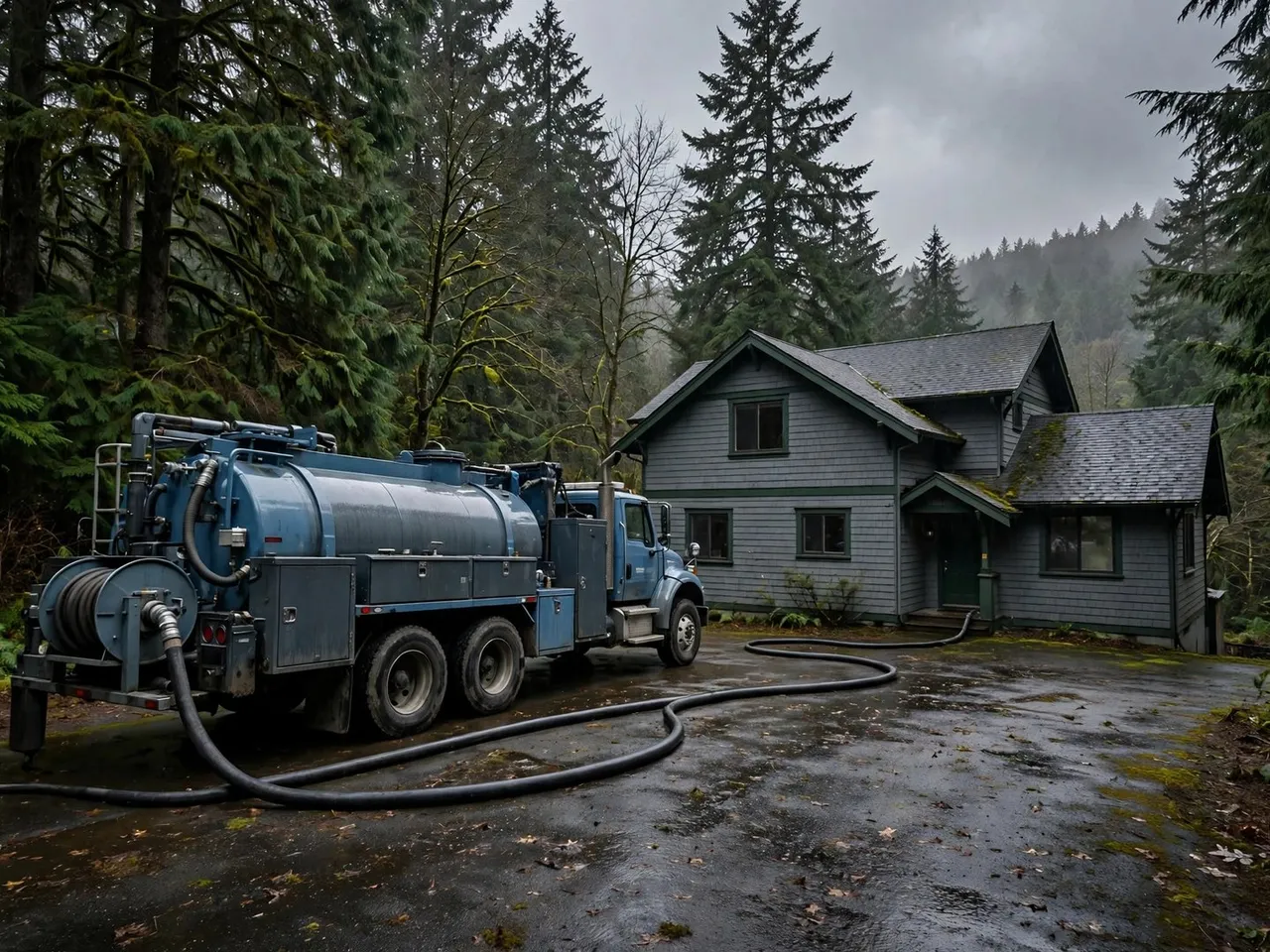
Septic pumping in Snohomish County starts at $650 — materially above the national average — and the typical range is $650–$1,000. That is the headline number to budget around. Everything below explains what sits behind it: what the price covers, what pushes it up, and the $100 county rebate that can take the edge off.
The local price, and why national figures mislead here
A local operator's published starting price is $650 for a tank up to 1,000 gallons, and $650–$1,000 is the typical range for a pumping visit in this county. Against that, the national average for pumping sits near $428 — a figure that does not apply here and will understate a Snohomish County job by roughly a third. Directory sites that quote a $380 average for Snohomish County are templated estimates, not local prices, and they contradict the named local operator's published $650 starting price. Use the local range.
The price covers removal and disposal of the tank contents, a post-pump check of the accessible components, and the county reporting the pumper files for you. Snohomish County tracks service history through its OnlineRME database, and a clean record is what a buyer — and the county's property-transfer inspection — will look for later. That reporting is part of what you are paying for, not an extra.
What changes the price
Tank size is the first variable: the $650 starting price covers a tank up to 1,000 gallons, and larger tanks cost more. Access is the second: if the lids are buried and need digging up, that adds time and cost, and older properties in the county's foothill and valley areas often have buried lids. Location matters too — providers travel further to reach Darrington, the Sauk River valley, and the eastern foothills than to reach the unincorporated ring around Everett, and travel shows up in the price. And if the visit finds a problem — a cracked baffle, a clogged filter, a failing pump — the repair is a separate job with its own price. Ask for a firm price before the work, and ask what is included: tank size, access, and whether lid-digging is extra are the three questions that prevent surprises.
How often you will pay it
As a general guide, most tanks need pumping every 3–5 years, depending on household size and tank size. More people and a smaller tank mean more frequent pumping. That puts the long-run cost of pumping at roughly $130–$330 a year — the cheapest maintenance a septic system has. Compare that with what waiting costs: solids carried over from a tank pumped too late clog the drainfield, and drainfield repair typically runs $3,000–$12,000 in this county, with replacement at $5,000–$20,000. Pumping on schedule is not the expensive option; it is the option that keeps the expensive ones away. Our guide on how often a septic tank should be pumped covers the interval in more detail.
The $100 Savvy Septic rebate
Snohomish County's Savvy Septic programme rebates $100 of a pumping visit for homeowners who complete the county's free online Septic Care Workshop first and use a certified provider. The rebate applies to work done in the last 12 months, and funding is first-come, first-served — check the current requirements before assuming reimbursement is guaranteed. The same programme rebates $100 of an inspection, $50 per riser (up to 2), and up to $200 of minor repairs, for up to $500 in combined rebates. Our Savvy Septic rebates guide lists every amount and the eligibility rules. Between 2023 and 2025, homeowners claimed 1,922 rebates worth nearly $223,860 — the programme is real money, not a token discount.
Pumping plus inspection: the combined visit
Pumping is often done at the same visit as an inspection, and that is usually the sensible way to buy both. A routine inspection typically runs around $500; a property-transfer inspection typically runs $750 plus the $245 county Report of Property Transfer fee. A combined inspection and pumping visit is often budgeted at $1,000–$1,500. That combination is especially common when a home is being sold: since November 1, 2026, Snohomish County generally requires a property-transfer inspection within 12 months of closing, and pumping is done at the same visit when the inspector recommends it. Our guide to the property-transfer rule explains that requirement in plain English, and our inspection page explains what the inspection covers.
When pumping will not fix the problem
Pumping is maintenance, not a cure. If the drainfield itself has failed — clogged soil that no longer absorbs wastewater — pumping the tank will not restore it, and the job becomes a repair, typically $3,000–$20,000 for drainfield work. The warning signs that the field, not the tank, is the problem are wet or unusually green areas over the drainfield, sewage smells near the field, and drains that stay slow after a pump. Our guide on signs a drainfield is failing covers how to tell the difference. If you are seeing those signs, say so when you book — a pumper who knows the field is suspect will look at the right things.
Getting a firm price
Every figure on this page is guidance only, never a quote — only a provider who knows your tank size, your access, and your location can confirm a price for your property. When you ask, give the provider three facts: the tank size if you know it, whether the lids are buried or have risers, and your town or ZIP code. Ask whether lid-digging is included, whether county reporting is included, and whether the price changes if pumping is combined with an inspection. And check the rebate first: completing the county's free workshop before the visit is what makes the $100 rebate available.
Prices last checked November 5, 2026. Sources: Septic Solutions LLC pricing guide (June 2026) and inspection pricing (October 2026); The Serviss Group; Stanwood Septic; Snohomish County Health Department Savvy Septic pages. See our Snohomish County septic costs page for every local figure with its source.
Need your tank pumped? Ask about septic tank pumping in Snohomish County — a local septic professional will get in touch, usually within an hour between 7am and 8pm Pacific.
Septic Tank Pumping in Snohomish County, WA